Custom Boxes vs. Stock Boxes: Which Is Best for Your Business?
Marketing Expert Team • June 29, 2026
If you're comparing custom boxes vs stock boxes, the short answer is this: stock boxes win on speed and low upfront cost, while custom boxes win on branding, fit, and long-term customer experience. Neither option is universally "better" the right choice depends on your order volume, budget, and how much your packaging needs to do double duty as a marketing tool. This guide breaks down the real costs, benefits, and trade-offs of each option so you can match your packaging strategy to your business stage, not just your gut instinct.
Key Takeaways
Stock boxes are pre-made, standard-sized cardboard boxes that ship fast and cost less per unit at low volumes.
Custom boxes are designed and printed to your exact specs, offering branding, perfect product fit, and a stronger unboxing experience.
Packaging design influences the purchasing decisions of roughly seven in ten consumers, making branded packaging a real growth lever, not just a cosmetic upgrade.
The global custom packaging market is on a steep growth curve, valued at roughly $48.17 billion in 2025 and projected to climb toward $81 billion by 2034, reflecting how many brands are shifting toward customization.
Most growing ecommerce and DTC brands eventually adopt a hybrid model — stock boxes for bulk shipping, custom boxes for flagship or gifting products.
What Are Stock Boxes? {#what-are-stock-boxes}
Stock boxes are pre-manufactured, standard-size cardboard boxes sold in bulk by packaging suppliers. They come in plain brown corrugated or white finishes, with no custom printing, and are ready to ship same-day or next-day in most cases.
Stock boxes exist because most products fall into a handful of common dimension ranges. Suppliers mass-produce these standard sizes — think small mailers, medium shipping cartons, and large moving boxes — and keep them in warehouse inventory. Because the manufacturing run is already done before you order, you're simply buying from existing stock rather than commissioning a custom production run.
For a business just starting out, stock boxes solve an immediate, practical problem: you need something to ship a product in today, not in three to four weeks. They're widely available from office supply stores, big-box retailers, and online packaging distributors like Uline, ULINE competitors, or local box manufacturers.
The trade-off is uniformity. Every stock box looks like every other stock box on the market — there's no logo, no internal branding, and often a size mismatch that forces you to use excess void fill (bubble wrap, paper, or air pillows) to keep products secure during transit.
What Are Custom Boxes? {#what-are-custom-boxes}
Custom boxes are packaging built to your brand's exact specifications — size, shape, material, print design, finish, and sometimes interior structure (inserts, dividers, or molded trays).
Custom packaging isn't just about slapping a logo on a brown box. It's a coordinated design process that touches structural engineering (so the box fits your product with minimal void space), material selection (recycled kraft, corrugated, rigid set-up boxes, etc.), and graphic design (full-color printing, foil stamping, embossing, or matte/gloss finishes).
This is precisely why the custom packaging segment has grown into a serious industry. Custom packaging moves far beyond selecting a standard box size, involving unique structural designs, material specifications, and graphic applications that serve as integral components of a product's identity, safety, and user experience. Brands increasingly treat the box itself as a marketing asset, not just a shipping container.
The catch is that custom boxes typically require a production run, meaning there's a minimum order quantity (MOQ) and a longer lead time usually two to six weeks, depending on complexity and your supplier's printing capacity.
Custom Boxes vs Stock Boxes: Key Differences {#key-differences}
Factor | Stock Boxes | Custom Boxes |
Branding | None — plain or generic | Full logo, color, and design control |
Lead Time | 1–3 days (in-stock items) | 2–6 weeks (design + production) |
Minimum Order Quantity | None or very low | Often 50–1,000+ units depending on supplier |
Cost Per Unit (low volume) | Lower | Higher |
Cost Per Unit (high volume) | Stays roughly flat | Drops significantly with scale |
Product Fit | Generic sizing, may need void fill | Precision-fit, reduces void fill and shipping cost |
Unboxing Experience | Functional, not memorable | Designed for shareability and brand recall |
Best For | Startups, internal shipping, B2B bulk freight | DTC brands, retail-ready products, gifting, subscription boxes |
Cost Breakdown: Custom Boxes vs Stock Boxes {#cost-breakdown}
At low order volumes, stock boxes almost always cost less per unit sometimes 30–60% less because there's no design fee, plate setup cost, or minimum print run to amortize. A business shipping fewer than a few hundred units a month will usually find custom packaging's per-unit price hard to justify early on.
That math flips as volume increases. Custom box pricing is heavily influenced by setup costs (die-cut tooling, printing plates, design proofing) that get spread across the entire order. Order 5,000 custom mailer boxes instead of 500, and the per-unit cost can drop by 40% or more, often landing close to — or even below — comparable stock box pricing, while delivering a fully branded product.
There are also hidden costs worth factoring in:
Void fill and labor: Stock boxes that don't fit your product well require more packing material and more time per shipment, which adds labor cost over hundreds of orders.
Damage and returns: Poorly fitted stock boxes increase in-transit damage, driving up replacement and return shipping costs.
Dimensional weight pricing: Carriers like UPS, FedEx, and USPS charge based on box size, not just actual weight. An oversized stock box can quietly inflate your shipping bill on every single order — something precision-fit custom packaging is specifically engineered to reduce, alongside lowering damage rates and material waste.
A simple rule of thumb: calculate your true cost per shipment (box + fill + labor + dimensional shipping fees), not just the sticker price of the box itself, before deciding.
Branding and Customer Experience {#branding-and-customer-experience}
This is where custom boxes pull ahead decisively. Packaging is often the very first physical touchpoint a customer has with your brand, especially in ecommerce and that first impression carries real commercial weight.
Survey data from the Paper and Packaging Board and Ipsos found that roughly seven in ten consumers (72%) agree that packaging design can influence their purchasing decision, and 67% said the packaging material itself shapes which product they choose. That same research found 68% of consumers would choose a paper or cardboard package over plastic when given the option, and 63% said cardboard packaging makes a product feel more premium.
Beyond the initial purchase decision, packaging shapes loyalty. User-friendly, well-designed packaging enhances satisfaction, encourages repeat purchases, and acts as a powerful communication tool throughout the buying process. For subscription boxes, beauty brands, and gifting-focused businesses, the "unboxing moment" has become a marketing channel in its own right fueled by social media shares of branded mailers, tissue paper, and inserts.
Stock boxes simply can't replicate this. A plain brown box communicates "shipment," not "brand." For businesses competing in crowded ecommerce categories, that distinction can directly affect repeat purchase rate and word-of-mouth referrals.
Durability and Product Protection {#durability-and-protection}
Durability depends less on "custom vs stock" and more on material grade and box construction but custom boxes have a structural advantage: they can be engineered around your exact product dimensions and weight.
A precision-fit custom box reduces internal movement during transit, which is one of the leading causes of shipping damage. Stock boxes, by contrast, are built to general-purpose dimensions, so unless your product happens to match a common size, you'll often need extra padding to prevent shifting.
That said, stock boxes aren't inherently weaker. Double-wall corrugated stock boxes can handle heavy freight just as well as a custom box of similar material grade. The real differentiator is fit, not strength a box that's too big for its contents is more likely to fail in transit regardless of whether it's custom-printed or plain brown.
For fragile, oddly shaped, or high-value items (electronics, glass, cosmetics in glass jars), custom inserts and molded trays only available through custom packaging provide protection that generic stock boxes and loose void fill simply cannot match.
Lead Time and Minimum Order Quantities {#lead-time-and-moq}
Speed is one of stock boxes' biggest practical advantages. Because they're already manufactured and warehoused, most suppliers can ship stock boxes within one to three business days, with no minimum order requirement in many cases. This makes them ideal for businesses that are testing a new product, scaling unpredictably, or simply can't commit to a large print run.
Custom boxes require a production cycle: design approval, proofing, die-cutting setup, printing, and quality control. Depending on your supplier and order complexity, this typically takes two to six weeks. Many custom packaging suppliers also require a minimum order quantity often somewhere between 50 and 1,000 units, though on-demand digital printing has started to lower these minimums industry-wide.
If your business has unpredictable demand or you're still validating product-market fit, the lead time and MOQ of custom packaging can be a real constraint. It's a common reason new ecommerce brands start with stock boxes and transition to custom packaging once order volume stabilizes.
Sustainability Considerations {#sustainability}
Sustainability is no longer a "nice to have" it's increasingly a baseline expectation from both consumers and regulators. The good news is that both stock and custom boxes can be made from recycled, recyclable, or biodegradable materials; sustainability is a material choice, not exclusively a custom-box feature.
That said, custom packaging has an edge in material efficiency. Because custom boxes are sized to fit the product, they typically require less void fill and generate less packaging waste per shipment compared to oversized stock boxes. Industry analysis points out that precision-engineered custom packaging helps minimize void fill and associated material waste while optimizing carton size for dimensional shipping weights a benefit that compounds across thousands of shipments.
On the stock box side, look for suppliers offering FSC-certified corrugated cardboard and post-consumer recycled content. Many large stock box distributors now offer "green" standard SKUs at little to no price premium, making sustainable stock packaging an accessible option even for small businesses not ready for custom production runs.
Use Cases: Which Businesses Should Choose Which {#use-cases}
Choose stock boxes if you:
Are pre-revenue or early-stage and need to conserve cash
Ship low volumes or highly variable order quantities
Primarily ship B2B freight where branding matters less than protection
Need packaging immediately, with no lead time to spare
Are still testing product-market fit before committing to packaging design
Choose custom boxes if you:
Sell direct-to-consumer and packaging is part of the customer experience
Have predictable, recurring order volume (subscription boxes, retail replenishment)
Compete in a visually driven category (beauty, food and beverage, apparel)
Want to reduce dimensional shipping costs through precision sizing
Are positioning your brand as premium, sustainable, or differentiated
Choose a hybrid model if you:
Ship flagship or hero products in custom boxes, but use stock boxes for bulk or back-office shipments
Want to test custom packaging on a single SKU before rolling it out brand-wide
Need to balance brand experience against cash flow, especially during growth phases
Common Mistakes Businesses Make {#common-mistakes}
Choosing custom packaging too early. Committing to a large custom print run before validating product demand can tie up cash in inventory you may not need.
Underestimating true shipping cost with stock boxes. Oversized stock boxes increase dimensional weight charges, often outweighing the box's lower sticker price.
Ignoring MOQ requirements when planning launches. Ordering custom boxes without buffering for 2–6 week lead times can delay product launches.
Treating packaging as an afterthought. Since a global Ipsos survey found 72% of consumers say packaging design plays an important role in purchasing decisions, skipping branding entirely can be a missed growth lever, not just a cosmetic choice.
Not testing packaging durability before scaling. Skipping drop tests or transit testing on either custom or stock packaging can lead to costly damage claims later.
Step-by-Step: How to Choose the Right Box {#step-by-step}
Calculate your monthly order volume. Low, unpredictable volume favors stock boxes; consistent, scalable volume favors custom.
Estimate your true cost per shipment, including void fill, labor, and dimensional shipping fees not just box price.
Assess your brand's reliance on unboxing experience. DTC, beauty, food, and gifting brands benefit most from custom branding.
Check your cash flow flexibility. Custom packaging requires upfront capital for a production run; stock boxes don't.
Test product fit and durability with sample boxes (custom or stock) before committing to a large order.
Decide on a hybrid approach if needed — custom for flagship products, stock for bulk or B2B shipments.
Industry Trends and Future Outlook {#trends-and-future}
The custom packaging industry is growing fast, and the data backs it up. The global custom packaging market was estimated at roughly $37.89 billion in 2024 and is projected to reach about $59.62 billion by 2033, while a separate analysis pegs the 2025 market at approximately $48.17 billion, growing to roughly $81.04 billion by 2034. Either estimate points the same direction: brands are investing more in customized packaging, not less.
Several forces are driving this shift:
E-commerce growth. The global custom packaging boxes market is evolving from a commoditized supply chain input into a strategic brand asset and consumer engagement tool, with e-commerce acting as a primary driver of that shift.
Sustainability mandates. Regulatory and consumer pressure on sustainability is moving from a marketing claim to a non-negotiable cost of entry, pushing both stock and custom suppliers toward recyclable and biodegradable materials.
Digital printing and lower MOQs. Advances in digital and on-demand printing are gradually reducing the minimum order thresholds that historically kept custom packaging out of reach for small businesses.
Smart packaging. QR codes and NFC tags are increasingly being integrated into packaging for consumer engagement, blurring the line between packaging and digital marketing.
Looking ahead, expect stock boxes to remain the default for early-stage and B2B shipping, while custom packaging supported by falling MOQs and digital print technology becomes accessible to a wider range of small and mid-sized brands, not just enterprise players.
Case Study: Switching From Stock to Custom Boxes {#case-study}
Problem: A small skincare brand selling through their own ecommerce store was using generic stock mailer boxes. Customer feedback consistently mentioned the packaging felt "cheap" relative to the premium price point of the product, and social media unboxing mentions were close to zero.
Solution: The brand worked with a packaging supplier to design a custom mailer box sized precisely to their bestselling product bundle, using kraft board with one-color branded printing and a custom interior insert to hold bottles securely. They kept using stock boxes for bulk wholesale shipments to retailers, where unboxing experience mattered less.
Results: Within two quarters, the brand saw an uptick in unprompted social media unboxing posts and a measurable increase in repeat purchase rate among DTC customers, while their wholesale shipping costs stayed flat since those orders remained on lower-cost stock boxes. The hybrid approach let them invest branding dollars where it had the most commercial impact.
Expert Insight
"Packaging decisions shouldn't be made in isolation from your unit economics. The right question isn't 'custom or stock' — it's 'where in my business does packaging need to work harder, and where can it just get the job done?' Brands that answer that clearly almost always end up running a hybrid model." — Illustrative industry perspective, packaging strategy consulting
Visual Recommendations
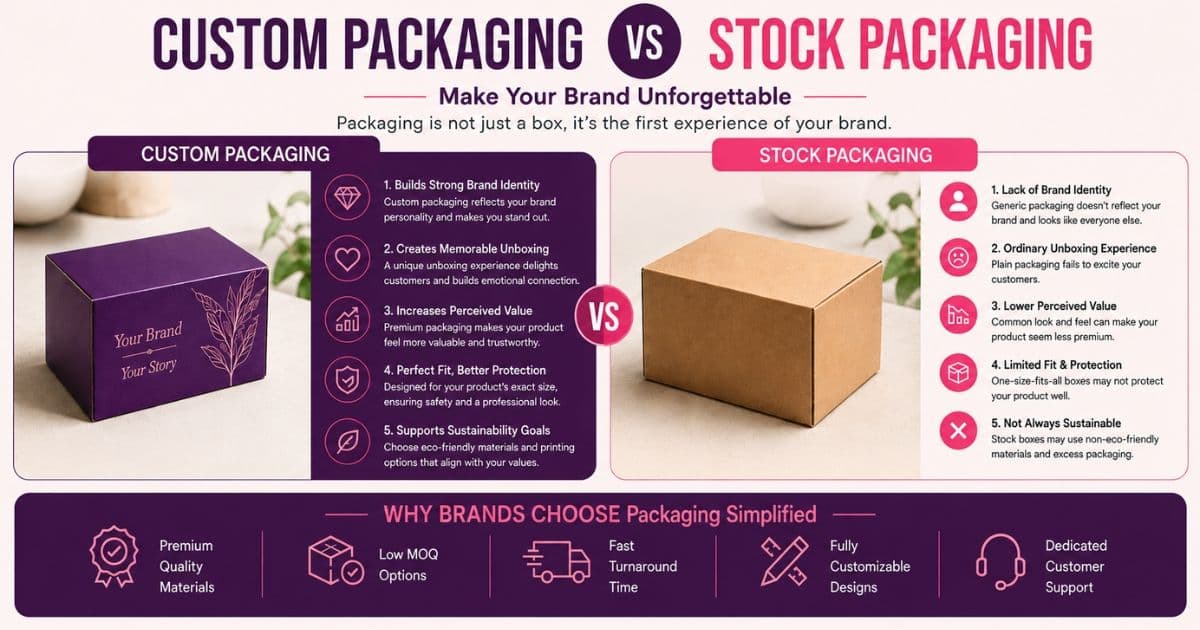
Infographic: "Custom Boxes vs Stock Boxes at a Glance" — side-by-side icons for cost, speed, branding, MOQ. Alt text: "Infographic comparing custom boxes and stock boxes across cost, speed, and branding."
Bar chart: Per-unit cost curve showing how custom box pricing drops as order volume increases, compared to flat stock box pricing. Alt text: "Chart showing custom box cost per unit decreasing with higher order volume."
Process diagram: Custom box production timeline (design → proof → print → ship). Alt text: "Diagram of the custom packaging production timeline from design to delivery."
Photo carousel: Real unboxing experience examples from DTC brands. Alt text: "Branded unboxing experience photo from a direct-to-consumer skincare brand."
Conclusion
There's no single right answer in the custom boxes vs stock boxes debate — only the right answer for your business stage, budget, and brand strategy. Stock boxes offer speed, low commitment, and flexibility, making them a smart default for early-stage or unpredictable-volume businesses. Custom boxes offer branding power, precision fit, and a stronger customer experience, which pays off once your order volume and brand positioning justify the investment.
For many growing businesses, the smartest move isn't choosing one over the other — it's building a hybrid packaging strategy that uses each option where it delivers the most value. If you're ready to explore what custom or stock packaging could look like for your products, [Packaging Simplified]'s packaging team is happy to help you map out the right next step.