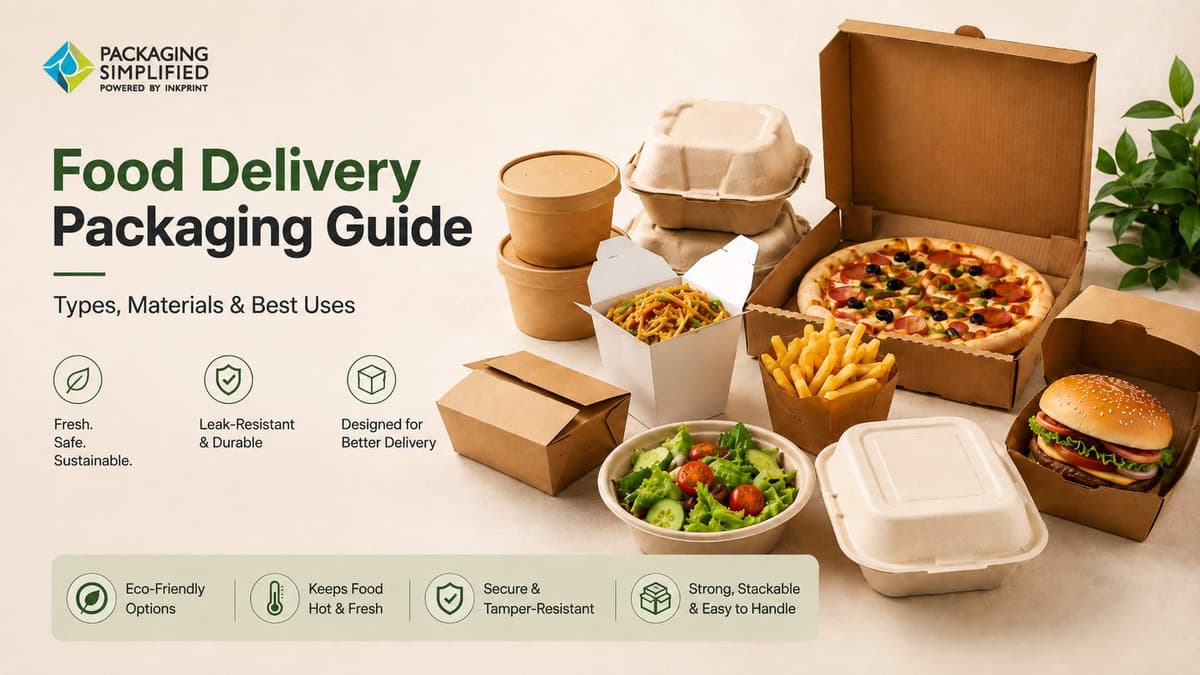
Best Food Delivery Packaging for Restaurants: Types, Materials & Uses
Team Packagingsimplified • August 19, 2026
Food can leave the kitchen looking exactly right and still arrive soggy, cold, crushed, or leaking. When that happens, it's rarely the recipe's fault — it's the food delivery packaging. Delivery adds variables dine-in service never deals with: time in transit, temperature swings, and containers stacked in a hot delivery bag.
Good delivery packaging manages all of that at once: holding in heat without trapping steam, resisting grease and moisture, surviving stacking, and still presenting food the way it looked when it left the kitchen. Restaurants also have to weigh cost per unit, sustainability expectations, and whether the packaging supports their brand.
This guide breaks down what food delivery packaging needs to do, which food delivery packaging boxes and materials work best by menu item, and how to choose the right combination for your own restaurant.
What Is Food Delivery Packaging?
Food delivery packaging is built to protect food quality over a delivery window — typically 15 to 45 minutes or more — rather than just holding food for a short walk to a table. It manages heat, moisture, grease, and physical movement while sealed, stacked, and transported.
That's the key difference from standard takeaway packaging: a clamshell meant for a five-minute car ride doesn't need the ventilation or structural strength of a box that will sit in an insulated bag, get stacked under other orders, and ride over potholes for half an hour.
Why the Right Food Delivery Packaging Matters
Packaging failures show up as complaints, refunds, and bad reviews — and they're usually preventable. The right packaging affects:
● Temperature and food safety — hot food needs to stay warm longer than a kitchen pass; cold food needs to stay cool without sweating.
● Moisture and steam control — trapped steam is one of the most common causes of soggy delivery food.
● Leak and spill prevention — escaped sauce doesn't just ruin one dish, it can damage everything else in the bag.
● Texture and presentation — food that arrives looking like it did in the kitchen builds trust with customers who've never seen the dining room.
● Overall customer experience — for delivery-first concepts, packaging is often the only physical touchpoint a customer has with the brand.
What Makes Good Food Delivery Packaging?
Not every attribute matters equally for every dish, but a few criteria come up across the board:
Food-grade suitability is non-negotiable for anything touching food directly — in the U.S., materials that contact food fall under FDA food contact substance regulations, which govern what can safely be used in packaging construction. Leak resistance matters most for sauces and soups. Grease resistance protects texture and keeps oil from soaking through to the delivery bag. Ventilation lets steam escape so crispy food doesn't go soft — though too much ventilation lets heat escape faster. Heat retention keeps food warmer longer, but heavier insulation without ventilation can trap more condensation. Moisture control and structural strength determine whether a container holds its shape. Secure closures and stackability matter operationally, since drivers carry multiple orders at once. Portion compatibility, delivery distance, and sustainability expectations round out the list.
The trade-offs are real: stronger heat retention isn't automatically better if trapped steam makes fried food soggy. Good packaging balances several of these factors rather than maximizing just one.
Best Food Delivery Packaging by Food Type
There's no single container that works for an entire menu — the right packaging follows the food.
Food Type | Key Packaging Need | Suitable Packaging Feature |
Pizza | Heat retention + ventilation | Corrugated vented pizza box |
Burgers | Heat retention + grease control | Grease-resistant carton |
Fried food & fries | Steam management | Ventilated packaging or vented sleeves |
Noodles & pasta | Leak protection | Secure, deep container with tight lid |
Dosa | Shape retention + ventilation | Long, structured box |
Momos / dumplings | Steam & condensation control | Vented or partially ventilated container |
Salads & cold meals | Freshness + separation | Secure cold-food container, divided compartments |
Wraps & sandwiches | Grease control + compact handling | Foil-lined or grease-resistant wrap |
Pizza: A corrugated box holds shape under stacking, resists grease, and lets steam vent instead of condensing on the lid and dripping back onto the crust. Restaurants with heavy delivery volume often look at custom pizza boxes with branded printing, since the box becomes part of the experience for a food that's rarely eaten right at the door.
Burgers: A grease-resistant carton with a snug, vented lid keeps the bun from steaming into mush while still holding enough heat for the patty. Loose wrapping alone often isn't enough beyond a few minutes.
Fried food and fries: This is the hardest category to deliver well, since crispness and heat retention pull in opposite directions. Perforated liners, vented lids, or paper sleeves let moisture escape instead of turning food soft.
Noodles and pasta: Sauce means leak resistance and closure security matter more than ventilation. A deep container with a tight lid — and sauce portioned separately when possible — keeps noodles from sitting in pooled liquid.
Dosa: Its length makes shape retention a real packaging challenge. A long, structured box that matches the food's shape, with some ventilation, helps preserve both form and crispness.
Momos/dumplings: These generate steam in a small enclosed space that condenses quickly on sealed lids, leaving wrappers gummy. Partial ventilation or steam-release features help keep texture closer to fresh.
Salads and cold meals: Priorities flip for cold food — keeping ingredients cool, dry, and separated. Dressing packaged apart from greens prevents wilting, and a secure seal keeps everything cold and intact.
Wraps and sandwiches: Compact, grease-resistant packaging holds shape without added bulk. Foil or grease-resistant paper suits handheld items; boxed formats make sense when paired with sides.
Common Materials Used in Food Delivery Packaging
Corrugated board offers strength and stacking support, common in pizza boxes and larger delivery boxes, with some natural insulation from its fluted structure.
Paperboard is lighter than corrugated board, suited to cartons and smaller boxes where heavy-duty strength isn't the priority.
Kraft-based packaging offers natural grease resistance and is widely used for bags, wraps, and liners.
Bagasse, made from sugarcane fiber byproduct, is sturdy and naturally grease- and moisture-resistant — common for plates, bowls, and clamshells.
Molded fiber is shaped under heat and pressure into rigid trays, offering good structural strength for its weight.
Plant-based materials are derived from renewable sources rather than petroleum, though the environmental profile varies by specific material and processing method.
Recyclable materials only reduce landfill impact where local recycling infrastructure actually accepts them, which varies by material and municipality.
These terms aren't interchangeable. Recyclable means a material can be reprocessed through an existing recycling stream. Compostable means it breaks down into usable compost under specific conditions — often industrial composting, not necessarily a backyard bin. Biodegradable is a broader, less defined term for breaking down naturally over time, without a set process or timeframe. Plant-based describes the material's source, not its end-of-life behavior — a plant-based container isn't automatically compostable, and a compostable one isn't useful where no composting facility exists.
Because food-contact and environmental claims fall under FDA and FTC standards that get updated periodically — FDA's food contact substance rules govern which materials can safely touch food, while the FTC's Green Guides govern how packaging can be marketed as recyclable, compostable, or eco-friendly — restaurants making specific claims on packaging or marketing should verify current requirements with those agencies rather than relying on general industry language.
Packaging for Hot Food vs. Cold Food
Hot food packaging manages heat, steam, and condensation together. Full insulation without ventilation traps steam, which condenses on the lid and drips back onto the food; some ventilation lets moisture escape, but too much lets heat escape with it. The right balance depends on the dish — a burger benefits from more sealing than an order of fries.
Cold food packaging works differently: the priority is keeping contents cool, preventing moisture from wilting fresh ingredients, and sealing tightly enough that liquids don't shift or leak. Ventilation isn't useful here — the goal is closer to an airtight, insulated seal.
How to Prevent Soggy, Leaking, or Damaged Food During Delivery
Why does fried food become soggy?
Steam has nowhere to go in a sealed container, so it condenses on the lid and drips back down. Ventilated packaging gives it an exit path.
Why do containers leak?
Usually container depth relative to liquid volume, lid seal quality, or using a container not rated for grease and moisture.
Why does pizza lose crispness?
The same condensation problem as fried food — a sealed box traps steam against the crust. Vented corrugated boxes address it directly.
Why does condensation build up?
Warm, moist air inside a sealed container meets a cooler surface, like the lid's underside. Ventilation reduces the buildup that causes it.
Why do stacked containers collapse?
Structural strength varies by material and design; thin-walled or under-rated containers can buckle under stacked weight in a delivery bag.
Why does food arrive cold?
Insufficient insulation or long delivery times. Matching insulation level to expected delivery time helps, though it isn't a substitute for reasonable delivery windows.
How to Choose More Sustainable Food Delivery Packaging
Sustainability comes down to more than material choice. Right-sizing packaging to the portion — rather than defaulting to oversized containers — reduces material use without changing performance. Fiber-based materials, including bagasse and molded fiber, generally offer more disposal flexibility than plastic where recycling or composting access exists, though this varies by location.
Paper-based doesn't automatically mean sustainable. A coated paper container that isn't recyclable, or a compostable container sent to a landfill because no industrial facility exists nearby, doesn't deliver the benefit its material suggests. Composting infrastructure in particular is still uneven across the country — EPA data shows only a small share of food waste nationally is composted rather than landfilled, largely because access to composting facilities varies so much by region. Recycling access varies similarly by U.S. city and county, so restaurants should consider what's actually available to their customers rather than assuming national uniformity. Minimizing unnecessary packaging — extra liners, redundant boxes, oversized containers — is often a more reliable lever than material selection alone.
Should Restaurants Use Custom-Branded Food Packaging?
Custom branding makes the most sense where packaging is a visible part of the customer experience — which, for most delivery-first and multi-location brands, it is. A logo or custom printing on delivery packaging helps with recognition, especially for repeat customers who see the box before the food.
Branding is secondary to function, though. A well-branded box that leaks or lets food go soggy does more damage than plain packaging that performs well. Smaller operations may not need custom printing until order volume justifies the cost; growing or multi-location brands benefit more from consistent branded packaging across locations.
How to Choose Food Delivery Packaging for Your Restaurant
Work through these questions for each menu category — most restaurants need more than one packaging solution:
1. What type of food is being packed — hot, cold, greasy, crispy, or liquid-heavy?
2. How long does delivery typically take in your service area?
3. Does the food release significant steam?
4. Does the item need ventilation, or would ventilation hurt it?
5. How much leak resistance does the dish actually require?
6. Will containers be stacked with other orders in a delivery bag?
7. What portion sizes does your menu offer?
8. Does branding matter for this concept, or is function the priority?
9. What sustainability expectations do your customers have, and what infrastructure exists locally?
10. What's a realistic packaging budget per order, given your margins?
Most menus need two or three packaging types rather than one universal container — a vented box for pizza, a grease-resistant carton for burgers, and a sealed container for cold items, for example.
Choosing Packaging That Matches Your Menu
Delivery packaging isn't a single purchasing decision — it's a set of decisions made per menu category, based on how each dish behaves in transit. A pizzeria, a salad-focused fast-casual concept, and a fried chicken specialist need different combinations of ventilation, insulation, and closure security, even when all three are optimizing for the same outcome: food that arrives looking and tasting the way it did in the kitchen.
Restaurants evaluating their current packaging can start by matching containers to the failure points they see most — sogginess, leaks, cold food, or crushed boxes — rather than replacing everything at once. Packaging Simplified's food delivery packaging options span the materials and formats covered here, for restaurants ready to match packaging to their actual menu.